
Bangladesh is considering joining a newly formed defence alliance between Saudi Arabia, Pakistan, and Turkiye, with junior ministers stating that any decision would be based on national interests and a "Bangladesh First" policy. The pact, signed in Makkah, aims for collective deterrence.

Pakistan has received the second and final tranche of USD 1 billion from Saudi Arabia, completing a USD 3 billion aid package aimed at boosting its foreign reserves, the state bank said.

Pakistan, Turkiye, and Saudi Arabia have signed a trilateral defence pact, agreeing to treat an attack on one as an attack on all. Analysts suggest this alliance could significantly diminish the United States' strategic influence in West Asia and elevate Pakistan's geopolitical standing, potentially acting as a deterrent in regional conflicts.

Pakistan Prime Minister Shehbaz Sharif has once again thanked former US President Donald Trump for resolving the India-Pakistan conflict in May, despite India's consistent denial of third-party intervention.

A Financial Times report reveals Pakistan's crucial role in brokering a temporary ceasefire between the US and Iran, driven by White House concerns over rising oil prices and Iran's resilience.

Pakistan's Punjab government has approved a plan to restore the names of several streets and roads in Lahore, aiming to revive the city's pre-Partition heritage, an official said on Monday.

Iran's Deputy Foreign Minister Kazem Gharibabadi confirmed a peace deal with the United States, stating that Tehran will enter a 60-day negotiation period only after verifying Washington's commitments to ending hostilities, lifting the blockade, and releasing Iranian assets.
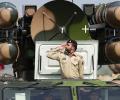
Pakistan has increased its defence budget by 17.6 per cent to PKRs 3,000 billion for the upcoming fiscal year, as announced by Finance Minister Muhammad Aurangzeb. The federal budget, estimated at PKRs 18,771 billion, targets 4 per cent GDP growth, with significant allocations for debt service and pensions. Prime Minister Shehbaz Sharif highlighted economic stability and ongoing discussions with the IMF, while the opposition protested Imran Khan's incarceration during the budget session.

Iranian President Masoud Pezeshkian has confirmed Tehran's participation in Pakistan-facilitated peace talks with the US in Islamabad, according to Prime Minister Shehbaz Sharif. This development follows a conditional ceasefire agreement and aims to address regional tensions.
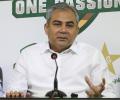
PCB chairman Mohsin Naqvi has been invited to attend the ICC Board meeting and IPL 2026 final in Ahmedabad, with Pakistan PM Shehbaz Sharif expected to decide on the visit amid ongoing India-Pakistan tensions.

Pakistan has significantly increased the price of high-octane fuel, impacting luxury vehicle owners, while also seeing increases in petrol, diesel, and airline fares due to rising global oil prices.

US President Donald Trump has lauded a newly announced peace deal between the United States and Iran, predicting it will bring "peace and security" to West Asia and facilitate the reopening of the strategically vital Strait of Hormuz.

Pakistan's Prime Minister Shehbaz Sharif contacted Saudi Crown Prince Mohammed bin Salman to express solidarity amidst escalating regional tensions following attacks in Iran and the Gulf region.

US President Donald Trump announced a finalised peace deal between the US and Iran, set for signing on June 19 in Switzerland, with key figures like J D Vance, Steve Witkoff, and Jared Kushner from the US side, and Abbas Araghchi and Mohammad Bagher Ghalibaf representing Iran, alongside Pakistani mediators Field Marshal Asim Munir, Shehbaz Sharif, Ishaq Dar, and Mohsin Naqvi, playing crucial roles in the diplomatic breakthrough.

US President Donald Trump on Friday said that the 'ceasefire' that he got done between India and Pakistan was a favour to their army chief Asim Munir and Prime Minister Shehbaz Sharif.

India has highlighted 13 key outcomes from the recent Shanghai Cooperation Organisation (SCO) summit, focusing on enhanced cooperation in security, counter-terrorism, and addressing transnational threats. These outcomes include the establishment of a Universal Centre for Countering Challenges and Threats to Security, a strong stance against state-sponsored terrorism, and agreements on narcotics control, climate change, and artificial intelligence, reinforcing India's engagement in the Eurasian region.

Doubts are emerging about Pakistan's role in mediating peace negotiations between the US and Iran, with suggestions that Islamabad's efforts are stalling and failing to secure a definitive response from the United States.

Former US President Donald Trump reiterated his claim of mediating the India-Pakistan conflict, stating that 11 jets were shot down during the May 2023 hostilities. He also suggested the conflict could have escalated to a nuclear level and claimed credit for averting a major catastrophe, a claim consistently denied by India which maintains no third-party intervention occurred.
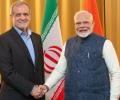
Prime Minister Narendra Modi has welcomed the understanding between the United States and Iran to end the conflict in West Asia, expressing hope that the pact will restore peace, stability, and ensure freedom of navigation in the region. The deal, aimed at ending a 107-day war that caused a global energy crisis, is set for signing on June 19.

US President Donald Trump and Pakistan Prime Minister Shehbaz Sharif have announced a landmark peace deal between the US and Iran, which includes the crucial reopening of the strategically important Strait of Hormuz and the immediate cessation of military operations in Lebanon.
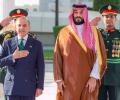
Prime Minister Shehbaz Sharif met with Saudi Crown Prince Mohammed bin Salman to express Pakistan's support for the Kingdom amidst escalating tensions in West Asia, reaffirming their mutual defence pact and commitment to regional stability.
'It beggars belief that Saudi Arabia would deploy military force against India, a top partner and market.'
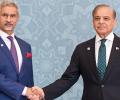
Shehbaz made the comments during a visit to the Kamra air base in the country's Punjab province where he interacted with officers and soldiers involved in the recent military confrontation with India.

Pakistan is actively engaged in diplomatic efforts to facilitate negotiations between the US and Iran, with hopes of hosting a second round of talks in Islamabad.

A question has been raised whether the Mecca Pact will have a negative impact on our doctrine that the Operation Sindoor has only been suspended and that it would be resumed if Pakistan engages in terrorism in the future. But the Mecca Pact only speaks of aggression, not defence against terrorism, points out Ambassador T P Sreenivasan.

Pakistan's Prime Minister Shehbaz Sharif chaired a high-level meeting to review regional and internal security in light of recent events in Iran and Afghanistan.

Top leaders from the US, Iran, and Pakistan, along with other nations, have gathered in Switzerland for high-level talks aimed at restoring peace in West Asia. These negotiations follow a recently signed Memorandum of Understanding between the US and Iran, initiating a 60-day window for a deal. Discussions focus on Iran's nuclear programme and the fragile interim peace deal, amidst renewed tensions and the fluctuating status of the Strait of Hormuz.

A powerful explosion ripped through a shuttle train in Pakistan's Balochistan province, resulting in numerous fatalities and injuries. The Baloch Liberation Army (BLA) has claimed responsibility for the attack.

The Pakistan Cricket Board is adapting the 2026 Pakistan Super League due to a fuel shortage, with matches played without fans and at only two venues.
Pakistan's Prime Minister Shehbaz Sharif has offered to host talks between the US and Iran to help resolve the ongoing conflict in the Middle East, following reports of Pakistan's involvement in backchannel diplomacy.
Seeking foreign loan had forced Pakistan to 'bow' its head and make compromises at the 'cost of self-respect', Prime Minister Shehbaz Sharif has said in a candid admission about the humiliation involved in approaching 'friendly countries' for financial aid.

Pakistan has intensified its efforts to bring the US and Iran back to the negotiating table to end the war in West Asia, following President Trump's extension of the ceasefire. Pakistani officials have engaged with Iranian, Turkish, and British counterparts to promote dialogue and diplomacy for a peaceful resolution.

Iranian Foreign Minister Abbas Araghchi visited Pakistan for the second time in three days amid uncertainty surrounding potential peace talks with the US. The visit follows discussions in Oman regarding regional security and efforts to resolve the Iran-US conflict.

A suicide car bomb attack on a police station in northwest Pakistan resulted in five deaths and thirteen injuries. The banned Tehreek-i-Taliban Pakistan (TTP) has denied responsibility, alleging the attack was orchestrated by state institutions.

Pakistan has deployed a military contingent, including soldiers and fighter jets, to Saudi Arabia as part of a joint strategic defence agreement aimed at enhancing military coordination and regional security.
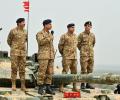
Lieutenant General Syed Aamir Raza's loyalty to Field Marshal Asim Munir during the turbulent times appears to have stood him in good stead, points out Rana Banerji, who headed the Pakistan desk at R&AW.
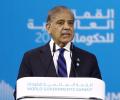
Prime Minister Shehbaz Sharif claims several countries are in talks with Pakistan to acquire its fighter jets following last year's conflict with India. The JF-17 Thunder is reportedly a key focus.

Iran has denied agreeing to participate in a second round of peace talks, contradicting claims made by the United States. The denial comes as tensions remain high in West Asia, with a ceasefire window nearing its end.
Any military response to a cross-border terror attack from Pakistan will have to take into account the new alignments beginning to take shape in the region, points out former foreign secretary Shyam Saran.
As the negotiations continued, the Iranian government said on social media that "talks between Iran and the US in Islamabad entered the expert-level stage as economic, military, legal, and nuclear committees joined in".
